
Functional Dissection of RNA-Organelle Hitchhiking
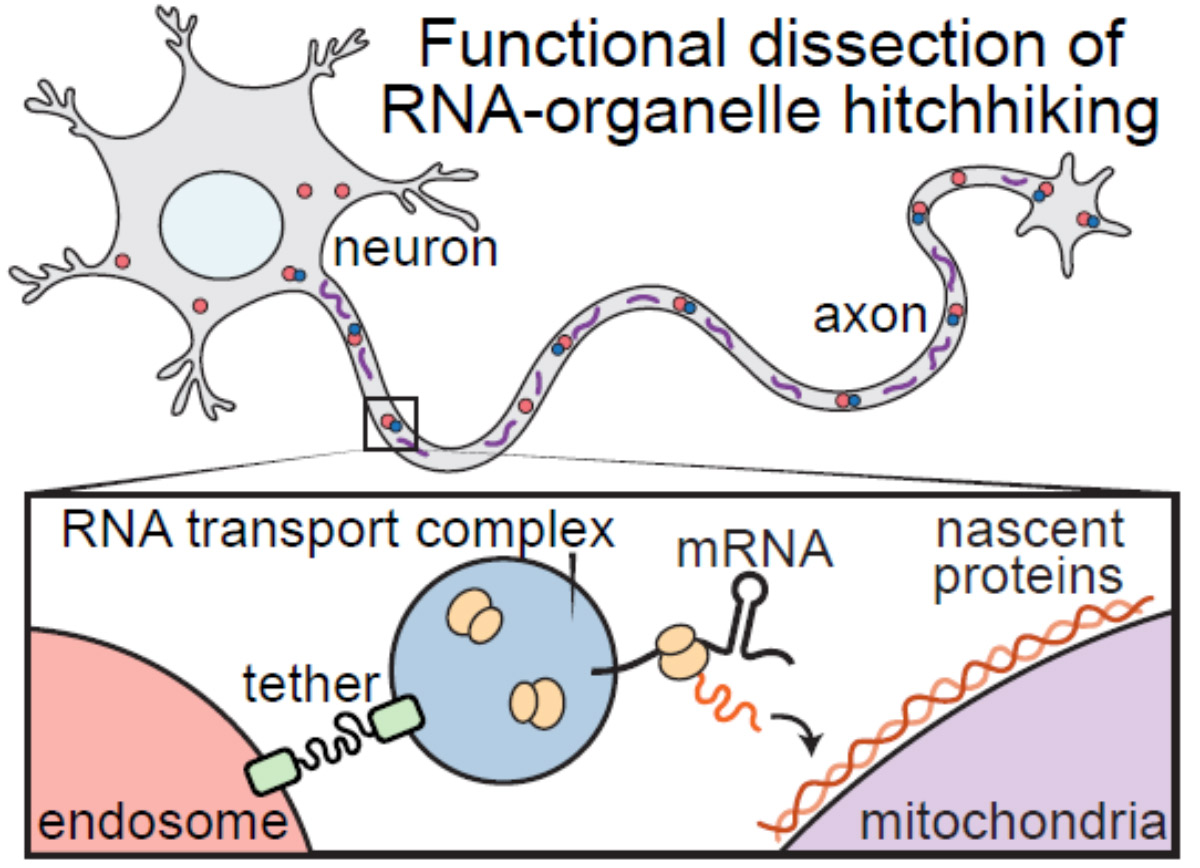
Messenger RNAs “hitchhike” on endosomes to travel down a nerve cell’s long axon. Along the way, they are decoded into proteins that help maintain the cell’s energy-generating mitochondria. Dr. Snead’s lab is identifying the molecular parts that make this process work.
The Snead lab at Northwestern University is uncovering how nerve cells ship genetic instructions to their farthest reaches by hitching them to intracellular shuttles, a delivery system that may hold the key to preventing axon damage seen in neurodegenerative conditions such as amyotrophic lateral sclerosis (ALS).
Nerve cells rely on the precise positioning of messenger RNAs (mRNAs)—the genetic instructions for building proteins—to make new proteins on demand, often far from the cell’s nucleus. This is especially critical in axons, the long, thread-like projections that carry signals across the nervous system and can extend thousands of times the length of the cell body. Scientists recently discovered that many of these mRNAs travel down axons by hitching a ride on endosomes, small membrane-bound organelles with essential roles in intracellular cargo transport. When this “hitchhiking” system breaks down, axons degenerate, a hallmark of diseases like amyotrophic lateral sclerosis (ALS). Yet, almost nothing is known about how mRNAs attach to endosomes, how they are turned into proteins along the way, or why this process matters for cell health. Dr. Wilton Snead’s lab is using cutting-edge imaging techniques to identify the molecular “tethers” that link mRNAs to endosomes, capture the moment an mRNA is decoded into protein during transport, and reveal how a protein made this way helps keep the cell’s energy-producing mitochondria healthy. This work will establish a new, mechanistic understanding of a transport pathway that sits upstream of multiple critical neuronal functions, laying the groundwork for future therapies aimed at the root causes of ALS and other neurodegenerative diseases.