
Engineering Liquid Semiconductors for Next Generation Computing
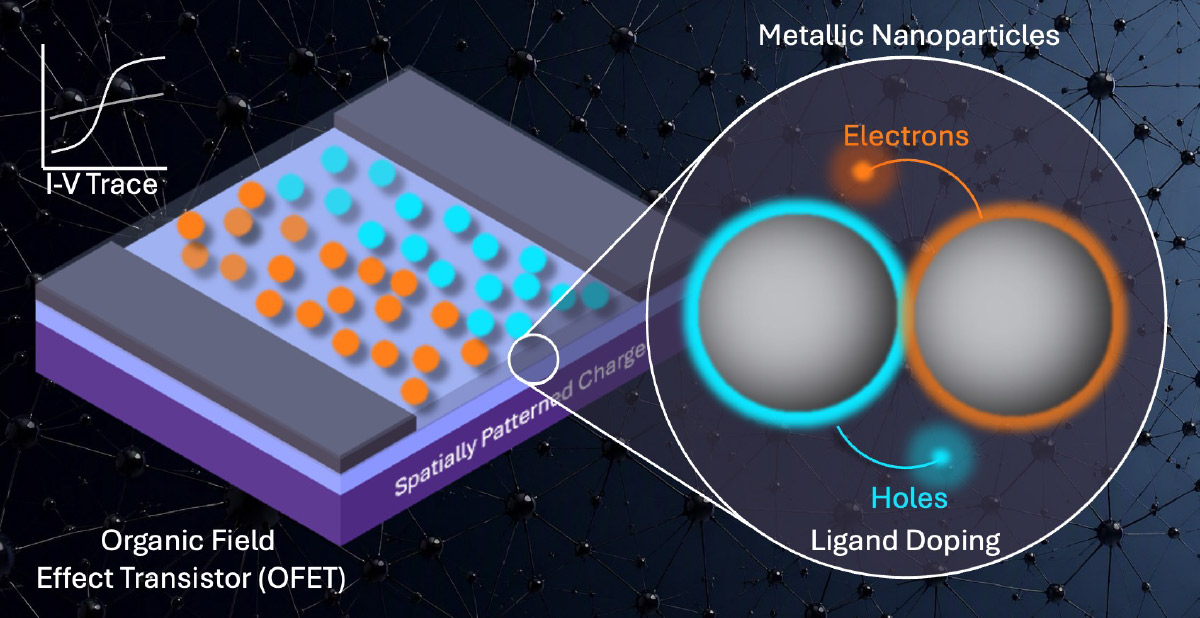
The Richards Lab at Northwestern is creating adaptive liquid semiconductors in which functionalized metallic nanoparticles and spatially patterned charge states serve as a foundation for flexible computing architectures.
The Richards lab at Northwestern University is exploring the physics of charge transport in soft semiconductors that mimic the functions and computing power of the human brain.
Silicon-based semiconductors currently form the basis of modern electronics, but the rise of artificial intelligence and its energy-intensive computations are showing the limitations of this technology. The Richards Lab is pioneering work on soft, liquid semiconductors that mimic the incredible plasticity, memory, and energy-efficient processing capabilities of the human brain. Similar to the brain where movement and position of ions and charged molecules between neurons enable computation and memory, this project aims to engineer liquid suspensions of nanoparticles with controlled charge distributions and transport. These new semiconducting materials consume much less energy than silicon-based semiconductors while enabling advanced technologies from neuromorphic devices to efficient AI.